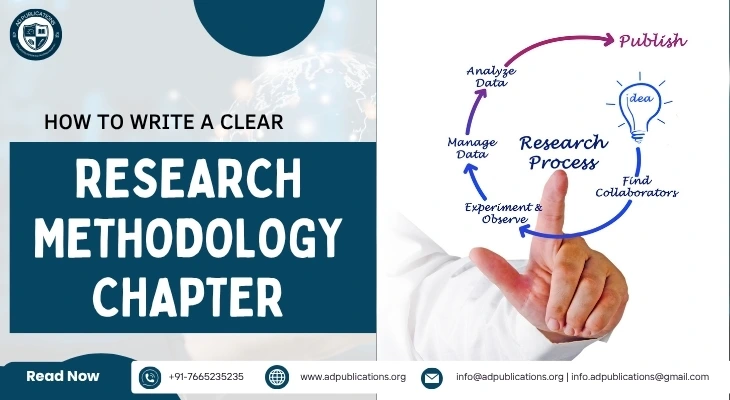
A research methodology chapter explains the methods, techniques, and procedures used to conduct a study. It demonstrates how data was collected, analyzed, and interpreted to answer the research questions or test hypotheses. This chapter serves as the foundation of research credibility because it allows readers to evaluate the reliability, validity, and overall quality of the study. Learning how to write a clear research methodology chapter is essential for producing rigorous and trustworthy academic work.
A well-written methodology chapter provides transparency, enabling other researchers to replicate the study if needed. It also justifies the selection of specific research methods and shows how they align with the research objectives. For additional support, explore our research support services to strengthen your manuscript.
Why a Clear Research Methodology Chapter Matters
The methodology chapter is one of the most scrutinized sections of any academic dissertation, thesis, or research paper. A clear methodology:
- Enhances the credibility of research findings
- Demonstrates academic rigor and professionalism
- Allows readers to assess the reliability of the results
- Supports the validity of conclusions
- Helps future researchers replicate or build upon the study
Without a detailed and structured methodology chapter, even valuable research findings may be questioned.
Identifying the Appropriate Research Approach
Before writing the methodology chapter, it is important to determine the research approach that best suits the study objectives.
Quantitative Research Approach
A quantitative approach focuses on numerical data, statistical analysis, and measurable variables. Researchers use this method when they aim to identify patterns, relationships, or causal effects.
Common quantitative methods include:
- Surveys
- Experiments
- Structured questionnaires
- Statistical modeling
Qualitative Research Approach
A qualitative approach explores experiences, opinions, behaviors, and social phenomena through non-numerical data.
Common qualitative methods include:
- Interviews
- Focus groups
- Case studies
- Observations
Mixed Methods Research Approach
Mixed methods research combines quantitative and qualitative approaches to provide a more comprehensive understanding of the research problem. This approach is beneficial when numerical data alone cannot fully explain the research phenomenon.
Explaining the Research Design
Research design outlines the overall framework used to conduct the study. It provides a roadmap for data collection and analysis.
- Descriptive Research Design: Focuses on describing characteristics, behaviors, or conditions without manipulating variables.
- Exploratory Research Design: Investigates topics with limited prior knowledge and seeks to generate new insights.
- Experimental Research Design: Examines cause-and-effect relationships by manipulating variables under controlled conditions.
- Correlational Research Design: Investigates relationships between variables without establishing causation.
When discussing research design, clearly explain why the selected design is most suitable for achieving the study objectives.
Describing the Research Setting
The research setting refers to the environment or location where the study was conducted. This section helps readers understand the context of the research.
Important details may include:
- Geographic location
- Industry sector
- Educational institution
- Community or organization
- Online or offline environment
Providing sufficient contextual information helps readers evaluate the relevance of the findings.
Defining the Target Population
The target population consists of individuals, groups, or entities that the research aims to study.
Clearly describe:
- Who the participants are
- Why they were selected
- Their demographic characteristics
- Their relevance to the research objectives
A detailed population description strengthens the study's applicability and relevance.
Explaining the Sampling Technique
Sampling refers to the process of selecting participants from the target population.
Probability Sampling
Probability sampling gives every member of the population an equal chance of selection.
Examples include:
- Simple random sampling
- Stratified sampling
- Cluster sampling
- Systematic sampling
Non-Probability Sampling
Non-probability sampling does not provide equal selection opportunities.
Examples include:
- Convenience sampling
- Purposive sampling
- Snowball sampling
- Quota sampling
Explain the rationale behind the chosen sampling method and specify the sample size.
Detailing Data Collection Methods
Data collection methods describe how information was gathered during the study.
Surveys and Questionnaires
Surveys are widely used for collecting quantitative data from large groups of participants.
Include details such as:
- Number of questions
- Distribution method
- Response format
- Data collection period
Interviews
Interviews allow researchers to gather detailed qualitative insights.
Specify:
- Interview type (structured, semi-structured, or unstructured)
- Number of participants
- Duration of interviews
- Recording procedures
Observations
Observational methods involve systematically recording behaviors, interactions, or events.
Explain:
- Observation type (participant or non-participant)
- Observation duration
- Recording techniques
Secondary Data Collection
Secondary data involves using existing sources such as:
- Academic journals
- Government reports
- Company records
- Industry publications
Describe the sources and selection criteria used.
Discussing Research Instruments
Research instruments are tools used to collect data.
Examples include:
- Questionnaires
- Interview guides
- Observation checklists
- Measurement scales
Provide detailed information about:
- Instrument structure
- Number of items
- Question types
- Measurement criteria
Including sample items can further improve transparency.
Establishing Validity of Research Instruments
Validity refers to the extent to which an instrument accurately measures what it is intended to measure.
- Content Validity: Ensures that all relevant aspects of the research topic are adequately covered.
- Construct Validity: Evaluates whether the instrument accurately measures theoretical concepts.
- Face Validity: Assesses whether the instrument appears effective based on expert judgment.
Explain the procedures used to validate research instruments before data collection.
Establishing Reliability of Research Instruments
Reliability refers to the consistency and stability of research measurements.
Common methods include:
- Test-Retest Reliability: Measures consistency over time by administering the same instrument multiple times.
- Internal Consistency Reliability: Evaluates consistency among questionnaire items using statistical measures such as Cronbach's Alpha.
- Inter-Rater Reliability: Measures consistency among different observers or evaluators.
Present reliability scores where applicable.
Before vs. After: Weak Methodology Chapter vs. Strong Methodology Chapter
| Aspect | Weak Methodology Chapter | Strong Methodology Chapter |
|---|---|---|
| Research approach | Vague or missing explanation | Clearly identifies quantitative, qualitative, or mixed methods |
| Research design | Not specified or poorly described | Clearly defines design type and justifies its selection |
| Sampling technique | No explanation of how participants were selected | Detailed description of sampling method and sample size justification |
| Data collection | Brief mention without specifics | Comprehensive description of instruments, procedures, and timeline |
| Validity and reliability | Not addressed | Explicit discussion of validity and reliability measures with scores |
| Ethical considerations | Overlooked entirely | Detailed explanation of consent, confidentiality, and data protection |
Explaining Data Collection Procedures
This section outlines the step-by-step process followed during data collection.
Key elements include:
- Obtaining permissions
- Recruiting participants
- Administering instruments
- Collecting responses
- Managing collected data
A chronological explanation improves clarity and replicability.
Describing Data Analysis Techniques
Data analysis techniques explain how collected information was processed and interpreted.
Quantitative Data Analysis
Common quantitative techniques include:
- Descriptive statistics (mean, median, mode, standard deviation)
- Frequency analysis
- Correlation analysis
- Regression analysis
- Hypothesis testing
Mention the software used, such as:
- SPSS
- R
- SAS
- Excel
Qualitative Data Analysis
Qualitative analysis often involves:
- Thematic analysis
- Content analysis
- Narrative analysis
- Grounded theory analysis
Describe coding procedures and theme development processes.
Mixed Methods Data Analysis
Explain how quantitative and qualitative findings were integrated to answer the research questions.
Addressing Ethical Considerations
Ethical compliance is a critical component of the methodology chapter.
Discuss measures taken to protect participants, including:
- Informed Consent: Participants should be informed about the study objectives and their rights before participation.
- Confidentiality: Personal information must remain private and secure.
- Voluntary Participation: Participants should have the freedom to withdraw at any stage without consequences.
- Data Protection: Explain how collected data was stored, secured, and accessed.
Demonstrating ethical responsibility enhances research integrity.
Acknowledging Research Limitations
Every study has methodological limitations that may affect findings.
Examples include:
- Limited sample size
- Geographic restrictions
- Time constraints
- Response bias
- Resource limitations
Discussing limitations openly demonstrates transparency and academic honesty.
Maintaining Clarity and Consistency Throughout the Chapter
A methodology chapter should be written in a logical and organized manner.
Best practices include:
- Using clear and concise language
- Maintaining consistent terminology
- Following institutional guidelines
- Presenting information in a structured sequence
- Supporting methodological choices with scholarly references
Well-organized content improves readability and strengthens the overall quality of the research document.
Tips by Academic Discipline for Writing Methodology Chapters
- Scientific Research Papers (Biology, Chemistry, Physics): Emphasize experimental procedures, equipment specifications, and controlled conditions. Include detailed protocols and safety measures. Report precise measurements and statistical tests.
Example emphasis: "Samples were prepared under sterile conditions at 25°C ± 0.5°C. Data were analyzed using one-way ANOVA with post-hoc Tukey tests." - Social Science Research (Psychology, Sociology, Education): Address participant demographics, recruitment strategies, and measurement instruments. Discuss potential biases and how they were mitigated. Include ethical approval details.
Example emphasis: "Participants were recruited through university email lists and received course credit for participation. Demographic data were collected to account for potential confounding variables." - Humanities Research (History, Literature, Philosophy): Focus on interpretative frameworks, textual analysis methods, and archival research procedures. Explain how sources were selected, evaluated, and interpreted.
Example emphasis: "Primary source materials were obtained from the National Archives and subjected to close textual analysis using critical discourse methodology." - Business and Management Research: Address organizational context, case selection criteria, and data access arrangements. Discuss practical considerations and industry relevance.
Example emphasis: "Four mid-sized manufacturing firms were selected based on their adoption of lean management practices. Access was negotiated through senior management, and interviews were conducted with department heads."
Checklist for Writing a Clear Research Methodology Chapter
- Have I clearly stated the research approach (quantitative, qualitative, or mixed methods)?
- Is the research design clearly defined and justified?
- Have I described the research setting and its relevance?
- Did I clearly define the target population?
- Is the sampling technique explained with rationale?
- Have I specified the sample size?
- Are data collection methods described in sufficient detail?
- Have I provided complete information about research instruments?
- Did I address validity and reliability procedures?
- Is the data collection process explained chronologically?
- Have I detailed the data analysis techniques used?
- Did I discuss ethical considerations?
- Have I acknowledged research limitations?
- Is the chapter written clearly and organized logically?
- Have I supported methodological choices with academic references?
A well-written methodology chapter is essential for establishing the credibility and trustworthiness of any research study. By clearly explaining the research approach, design, data collection methods, analytical techniques, and ethical considerations, researchers provide readers with confidence in the validity of their findings. A transparent and detailed methodology also enables other scholars to replicate the study, contributing to the broader academic community. Whether you are conducting quantitative, qualitative, or mixed methods research, following these guidelines will help you produce a clear, comprehensive, and academically rigorous methodology chapter that strengthens your overall research paper. For personalized guidance, you can book a consultation with our experts or explore our pricing plans.
Keep Exploring: Recommended Reads from AD Publications Blog
You may also find these articles valuable for your research and academic writing journey:
- How to Write a Good Literature Review for a Research Paper: A Complete Guide — Master the art of writing comprehensive and critical literature reviews.
- How to Write a Good Introduction for Research Paper: Complete Guide — Discover essential elements of crafting effective research paper introductions.
- How to Write a Good Abstract for a Research Paper: A Complete Guide — Learn to write compelling abstracts that get published and cited.
- Thesis and Dissertation Guide: Complete Process for Research Success — A comprehensive roadmap for structuring and completing your thesis or dissertation.
- SOP Writing Guide: How to Write a Winning Statement of Purpose — Craft compelling statements for university admissions and scholarships.